
Modern manufacturing enterprises generate vast amounts of data that must be effectively collected, processed, and analyzed to support decision-making. A well-designed, flexible data architecture enables smooth information flow from production devices and machines to analytical tools, maximizing operational efficiency and facilitating decision-making.
The modular approach to data architecture (also known as the Composable Approach) involves building an environment for collecting, storing, processing, and analyzing information based on pre-prepared modules (components). This can be compared to modular homes, which are built from pre-manufactured components.
The modular approach assumes building systems based on pre-configured, often low-code, cloud services within a single environment. An example of this is using the Microsoft Azure and Power Platform, where individual services serve different functions but work effectively together to create a cohesive ecosystem.
A modular data architecture for an OEE system in the IoT standard serves the following functions:
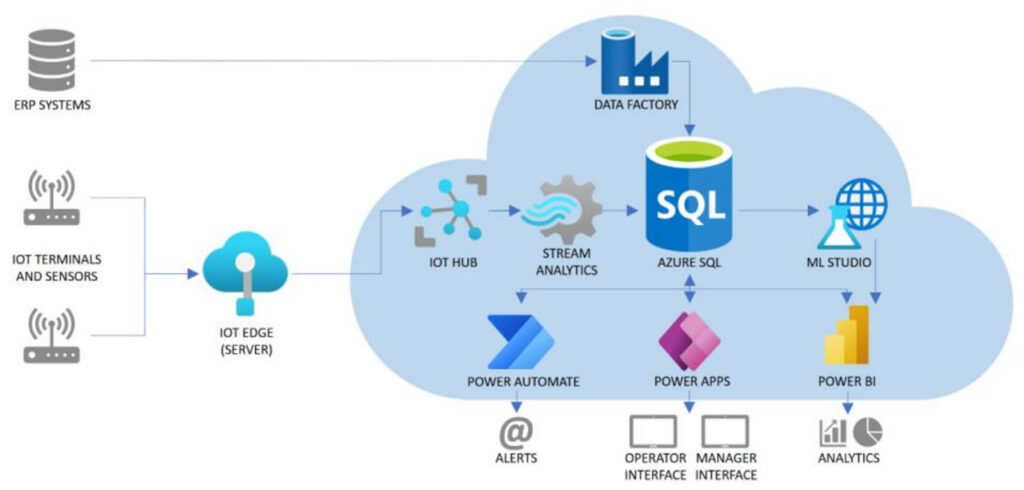
The architecture presented in the diagram shows an optimized data flow from IoT terminals and ERP systems to business applications:
Implementing a well-designed IoT architecture brings numerous benefits:
A well-planned, modular data architecture based on Microsoft Azure, IoT Hub, and Power Platform ensures effective data collection, processing, and analysis. By leveraging automation, real-time monitoring, and cloud analytics, companies can optimize operations and make better business decisions.
In the era of increasing importance of IoT data, adopting a scalable and secure data architecture model is crucial for long-term success. The combination of IoT Edge, Azure SQL, Power Automate, Power Apps, and Power BI transforms raw data into valuable insights, revolutionizing processes in industry, logistics, and other sectors