Data Architecture

View all articles

Modern manufacturing enterprises generate vast amounts of data that must be effectively collected, processed, and analyzed to support decision-making. A well-designed, flexible data architecture enables smooth information flow from production devices and machines to analytical tools, maximizing operational efficiency and facilitating decision-making.

The Concept of Modular Data Architecture

The modular approach to data architecture (also known as the Composable Approach) involves building an environment for collecting, storing, processing, and analyzing information based on pre-prepared modules (components). This can be compared to modular homes, which are built from pre-manufactured components.

The modular approach assumes building systems based on pre-configured, often low-code, cloud services within a single environment. An example of this is using the Microsoft Azure and Power Platform, where individual services serve different functions but work effectively together to create a cohesive ecosystem.

A modular data architecture for an OEE system in the IoT standard serves the following functions:
  • Real-time data collection IoT sensors and terminals continuously record data from production processes.
  • Edge and cloud processing – Raw data is pre-processed locally (IoT Edge) and sent to the Azure cloud (IoT Hub, Stream Analytics).
  • Data integration and analysis – Data is stored in a repository (Azure SQL), and then Power Automate, Power Apps, and Power BI enable process automation, user interaction, and data visualization.

Data flow in the Microsoft Azure ecosystem

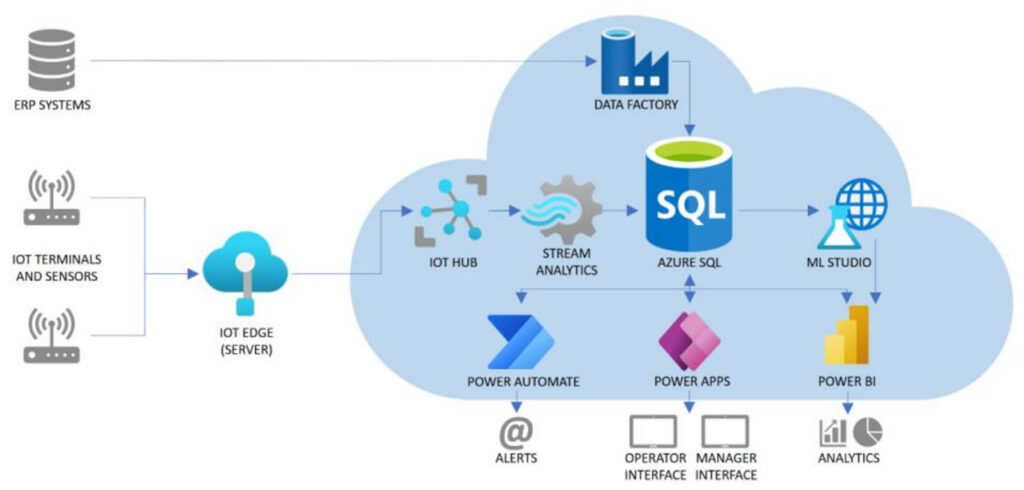
The architecture presented in the diagram shows an optimized data flow from IoT terminals and ERP systems to business applications:

  • IoT Terminals and Sensors – Collect data from production and transmit it via IoT Edge to Azure IoT Hub, ensuring secure and efficient transfer.
  • Azure IoT Hub – Acts as the central gateway for managing device connections and transmitting data to analytical services.
  • Stream Analytics & ML Studio – Real-time data processing with Azure Stream Analytics and predictive analysis using Machine Learning Studio.
  • Azure SQL Database – Structured data storage for historical analysis and integration with ERP systems and documents through Azure Data Factory.
  • Integration with Power Platform:
    • Power Automate – Workflow automation and real-time event notifications.
    • Power Apps – Interactive applications for operators, managers, and administrators.
    • Power BI – Creating dynamic dashboards for data visualization and analysis.

Benefits of an Optimized Data Architecture with a Modular Approach

Implementing a well-designed IoT architecture brings numerous benefits:

  • Seamless Data Integration – Enables smooth collaboration between IoT devices, databases, and analytical tools.
  • Real-Time Monitoring – Allows immediate response to changes in production processes.
  • Process Automation – Reduces manual operations through automatic processing and reporting.
  • Scalability and Flexibility – Supports growing data volumes thanks to Azure cloud infrastructure.
  • Advanced Security – Protects data through encryption and access control.

Summary

A well-planned, modular data architecture based on Microsoft Azure, IoT Hub, and Power Platform ensures effective data collection, processing, and analysis. By leveraging automation, real-time monitoring, and cloud analytics, companies can optimize operations and make better business decisions.

In the era of increasing importance of IoT data, adopting a scalable and secure data architecture model is crucial for long-term success. The combination of IoT Edge, Azure SQL, Power Automate, Power Apps, and Power BI transforms raw data into valuable insights, revolutionizing processes in industry, logistics, and other sectors

We respect your privacy
To take full advantage of the website, you must accept our Privacy Policy, which describes the use of personal data and cookies on the website. By clicking "Consent" you confirm that you know and accept the Privacy Policy.